
Week 10 | Intro | The Inherited Verdict: Casey Anthony
The gap between what evidence implies and what it can legally prove

Cindy Anthony called 911 at 2:49 p.m. on July 15, 2008.
She said she’d found her daughter’s car in an impound lot. She said the car smelled like a dead body. She said her granddaughter Caylee was missing. When the dispatcher asked how long the child had been gone, Cindy had to put the phone down and ask her daughter.
Thirty-one days.
Two years old. Missing for thirty-one days. In that time, her mother had entered a hot body contest at a nightclub, had a tattoo applied to her left shoulder — “Bella Vita,” beautiful life — and had told everyone who asked that Caylee was with a babysitter named Zanny. A babysitter nobody could locate. Because Zanny didn’t exist.
Welcome to Week 10 of Crime Reconstructed. This week is the Casey Anthony case. Before I say anything else, I want to tell you what this week is not.
This week is not a verdict. It’s not a reassessment of the jury, a relitigating of the trial, or an argument about whether the outcome was right or wrong. The jury spoke in July 2011. The courts have upheld that verdict. That is the legal record. What this week examines is the space between the legal record, the investigative record, and the factual record. In the Casey Anthony case, those three records don’t fully overlap. That gap is what’s worth understanding.
Here is how the week runs.
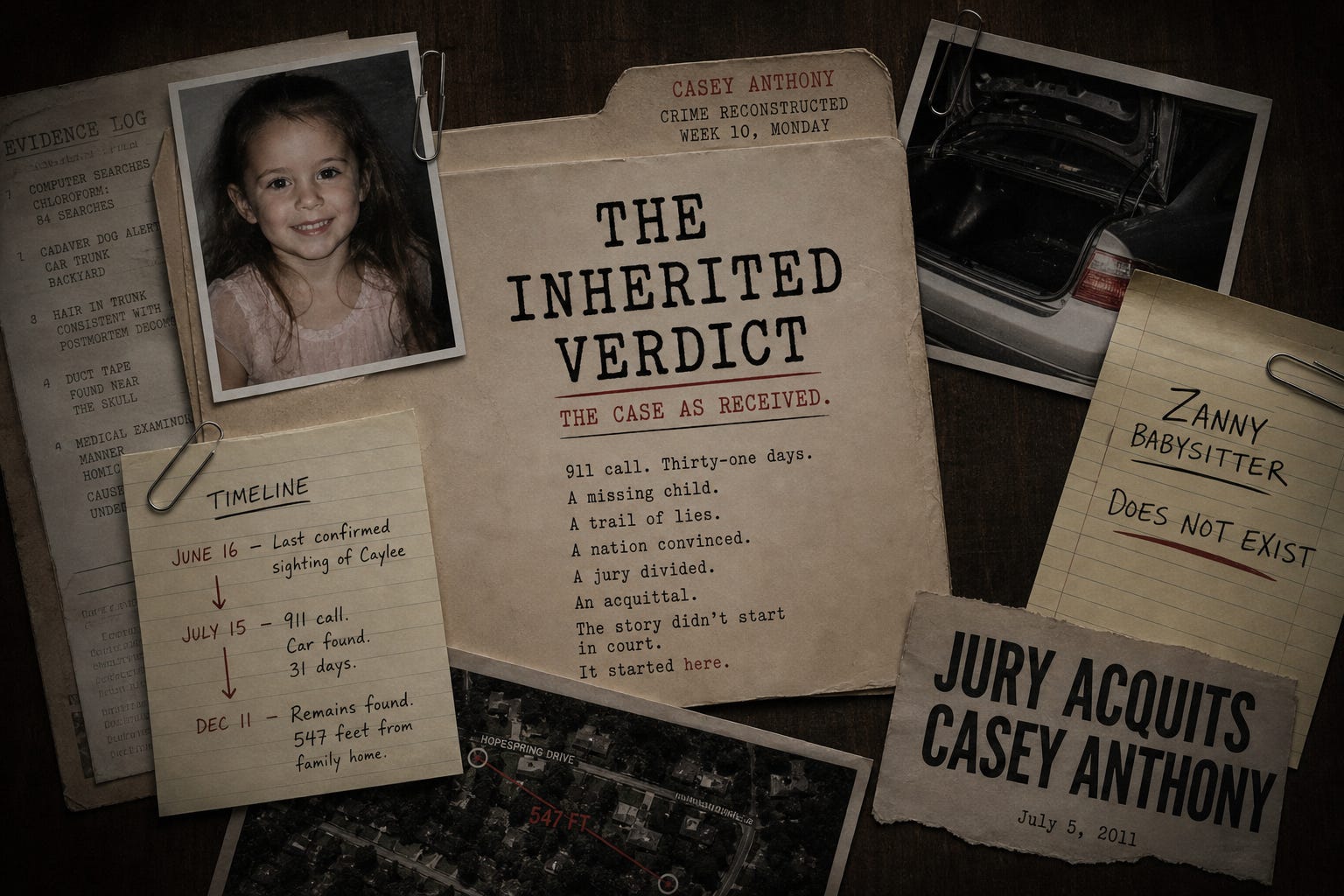
Monday — The Inherited Verdict. That’s this post. By the end of it, you’ll have the factual record of what the public was handed before anyone ran it through an analytical filter. The case as received.
Tuesday — The Assumption Stack. Every claim the investigation and prosecution built on, named and numbered before any of them are tested. Not stress-tested yet — catalogued. The full left column, laid out in daylight so you can see the architecture.
Wednesday — The Stress Test. Every assumption from Tuesday goes under load. The five system failures that shaped this case get mapped here too. What holds? What breaks? What does the cascade look like when you trace it honestly?
Thursday — Known vs. Knowable. The Map. Four categories — Established, Strongly Implied, Contested, and Permanently Unknowable — applied to the full Casey Anthony evidentiary record. The forensic window that closed in that Florida swamp is the defining feature of this case, and Thursday is where you see exactly what it cost.
Thursday Night — The Master Class. First Officer on Scene. We strip every assumption, every inherited narrative, every media frame, and we rebuild this investigation from June 16, 2008 forward. You are the detective. You know only what can be independently verified. What do you build?
Friday — The After-Action. What does the full methodology produce? What does this case add to the analytical record of the series? And what does a verdict teach when the evidentiary standard was correctly applied and the outcome still diverges from what the documented record most strongly implies?
Here is the case as delivered.
Caylee Anthony was two years old. She was last confirmed alive on June 16, 2008 — Father’s Day. Her grandmother called 911 thirty-one days later, July 15, after finding Casey’s car in an impound lot and recognizing the smell from the trunk. Caylee’s skeletal remains were found December 11, 2008, in a wooded area off Suburban Drive in Orlando — 547 feet from the Anthony family home on Hopespring Drive. Duct tape was found near the skull. The medical examiner ruled manner of death homicide. Cause of death: undetermined.
Casey Anthony was charged with first-degree murder. The prosecution presented computer searches for chloroform — 84 of them, the jury heard. Cadaver dog alerts on the car trunk and the Anthony backyard. Hair in the trunk consistent with postmortem decomposition. A 31-day window of documented lies about a fictional babysitter, a job that didn’t exist, and a timeline that couldn’t be verified. The defense presented a drowning theory, George Anthony as a co-conspirator in a cover-up, and a daughter’s history of abuse. Casey was acquitted of murder on July 5, 2011.
Nancy Grace called it the most shocking verdict since O.J. Simpson. The public, by substantial consensus, had reached a different conclusion years earlier.
That is the inherited verdict. The conclusion that formed before the evidence was formally tested, hardened through continuous coverage, and produced the specific kind of certainty that a jury verdict, when it diverged, couldn’t dislodge.
This week, we take it apart. Not to replace it with another one. To understand precisely what it was built on — and precisely what it was missing.
Tomorrow: the Assumption Stack. Every load-bearing claim in this case, named and numbered before we test a single one.
Audio establishes the frame. Writing does the work.