
Building the Frame
The Five-Operation Method That Replaces the Smoking Gun

A house built on one beam is a house waiting to collapse.
You can make the beam impressive. You can make it the strongest, most dramatic, most visually convincing beam anyone has ever seen. But the load is still concentrated in one place. Challenge that one place — a storm, a shift in the foundation, a single crack — and the structure comes down.
That is the smoking gun model of investigation. One artifact. One conclusion. Everything depending on the strength of a single piece.
This week we’ve torn that model apart. Monday we named the myth. Tuesday we audited the assumption that singular evidence can carry a case and watched it fail three structural tests. Wednesday we stress-tested the institutional machine that keeps the myth alive — four pressure points, all aligned toward the wrong kind of evidence.
Tonight in the Master Class, we rebuilt. Not with a better beam. With a frame
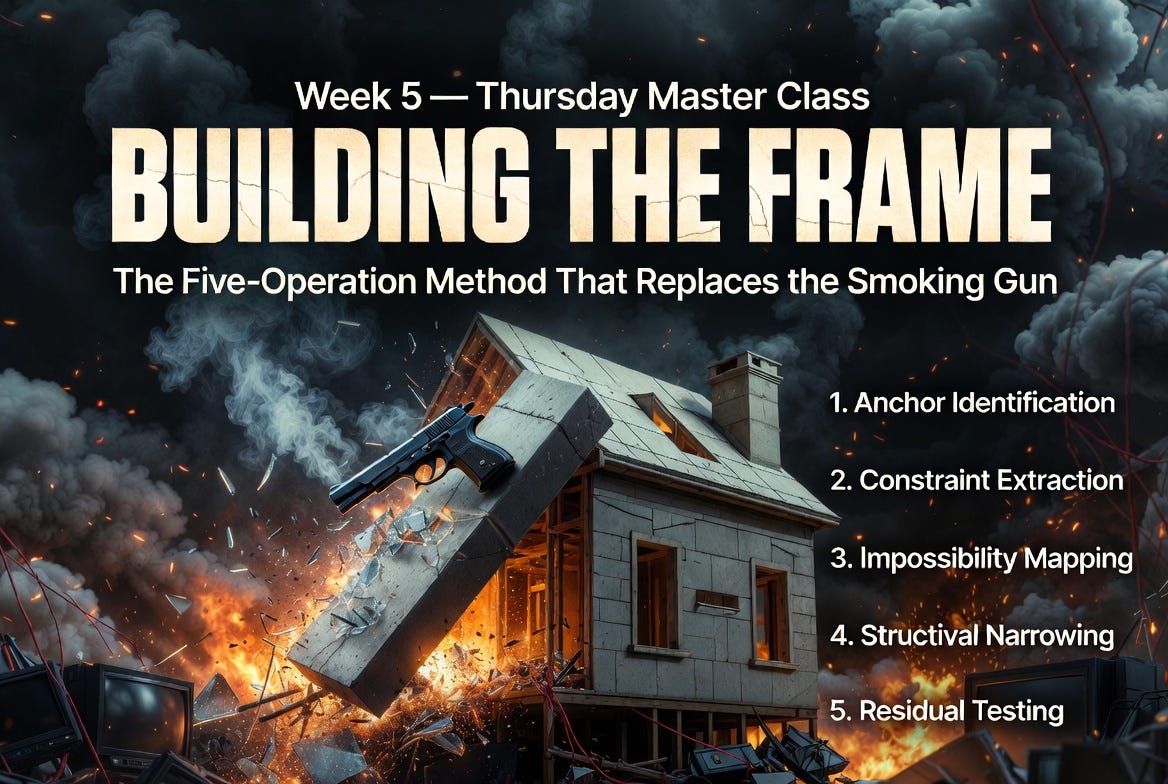
Constraint accumulation is the operational alternative to the smoking gun. It doesn’t look for the one artifact that proves the conclusion. It builds a structure that eliminates every alternative until only the truth remains.
The method runs through five sequential operations. Each one builds on the one before it.
Operation One is Anchor Identification. An anchor is a fact that does not require interpretation to establish. Physical laws — a body cannot travel faster than physics allows. Temporal records — a transaction logged by an independent system with no motive to distort. Biological constraints — a person cannot be in two places simultaneously. Most of what an investigation collects is not anchor-grade material. The discipline of this step is restraint. You build the foundation on the things that cannot move. Everything else gets tested against them.
Operation Two is Constraint Extraction. Once you’ve identified the anchors, you extract the constraints they impose — not what the evidence means, but what it forbids. A phone record shows a device in the northern sector at 11:14 PM. The crime occurred in the southern sector at 11:22. Transit between the two takes twenty-three minutes minimum. The constraint: that device could not have been at the crime scene at the time of the event. No theory required. No narrative constructed. Just a boundary condition that eliminates a possibility.
Interestingly enough, this happened with a set of brothers who were not twins, but they looked so much alike it appeared one person was in a place they could not be.
Operation Three is Impossibility Mapping. This is where the method becomes visual. Each constraint is rendered as a wall. The walls define the space inside which the event must have occurred. Everything outside is impossible. Whiteboard, legal pad, digital tool — the format doesn’t matter. What matters is that the constraints leave one investigator’s head and become visible to the entire team. Three rules govern the map: every wall must derive from an anchor, walls only contract, and the map belongs to the team — not to any theory.
Operation Four is Structural Narrowing. When enough constraints accumulate, the space of possible explanations shrinks until what remains can be individually examined. This is the moment people confuse with the smoking gun — it feels like a breakthrough, like something was discovered. But nothing was discovered. Things were removed. The surviving explanation didn’t appear. It survived. That’s a fundamentally different epistemic status. And it changes everything about how the conclusion holds under pressure.
Operation Five is Residual Testing — the step most investigations skip. It asks whether the surviving explanation is positively consistent with every constraint on the map. It’s not enough that every alternative was eliminated. The remaining answer must satisfy every boundary. If it violates even one, the narrowing is incomplete. Something was missed. This is the quality control that separates durable conclusions from fragile ones.
The difference between these two models shows up when someone finally pushes back.
A smoking gun cannot be structurally verified. It either exists or it doesn’t. You either believe it or you challenge it. If the challenge succeeds, the entire case collapses — because nothing else was carrying the load.
A constraint-accumulated conclusion comes with a built-in audit trail. Every anchor is documented. Every constraint is recorded. Every eliminated alternative is listed alongside the specific constraint that removed it. A defense attorney can challenge any single constraint, and the remaining structure still holds. The load is distributed across the frame, not concentrated in one piece.
If a case rises and falls on a singular piece of evidence, then the job of the defense becomes exceedingly easy.
Helmuth von Moltke said no battle plan survives initial contact with the enemy. The investigative version: no singular artifact survives initial contact with a competent defense attorney. But a frame — a properly constructed constraint structure — doesn’t need any single piece to survive. It needs the architecture to hold.
And architecture holds when every joint has been tested.
Tomorrow we step back and look at the full week’s arc. What survives after five days of analytical pressure? And what changes when we stop waiting for the smoking gun and start building the frame?
Audio establishes the frame. Writing does the work.